
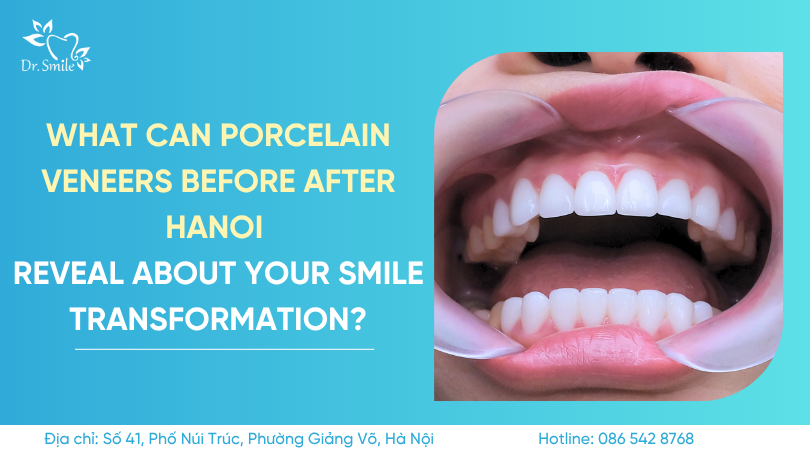
When people search for porcelain veneers before after Hanoi, they are usually looking for more than dramatic smile photos. They want to understand what may realistically change, how natural the result can look, and whether veneers can address the specific imperfections they notice in their own teeth.
Today’s dental patients are increasingly interested in personalized cosmetic dentistry rather than identical “perfect” smiles. They want teeth that look brighter and more balanced while still matching their facial features and personality. This makes before-and-after information especially useful because it helps patients understand the potential transformation while keeping realistic expectations.
How to read porcelain veneers before after Hanoi results realistically
Before-and-after photographs can provide a helpful visual reference, but they should not be interpreted as a guarantee of a particular result. Every smile has different tooth proportions, gum contours, facial characteristics, and underlying dental conditions.

A useful comparison should ideally show:
- The patient’s original smile from a similar angle
- Comparable lighting before and after treatment
- The shape and proportions of the teeth
- Changes in tooth color and translucency
- Improvements in alignment or symmetry
- The relationship between teeth and gums
- The overall effect on the patient’s smile
When reviewing porcelain veneers before after Hanoi, pay attention to details rather than simply asking whether the final teeth look “whiter.”
A natural-looking veneer result often involves subtle changes. The teeth may appear more symmetrical, the edges may look smoother, and the overall smile may become more harmonious without looking artificial.
Another important factor is facial proportion. A veneer design that looks attractive on one person may not produce the same visual effect on another. Tooth width, length, lip movement, skin tone, facial shape, and the visibility of the teeth when smiling can all influence the final appearance.
What changes can porcelain veneers create?
One reason porcelain veneers before after Hanoi searches are so popular is that veneers can address several cosmetic concerns within one treatment plan.
Depending on individual circumstances, porcelain veneers may help improve the appearance of:
- Stubborn discoloration: Some intrinsic stains do not respond sufficiently to conventional whitening. Veneers can provide a new visible surface with a carefully selected shade.
- Small chips and worn edges: Minor damage can make teeth appear uneven. Veneers can restore a smoother and more consistent appearance.
- Uneven tooth proportions: Teeth that appear unusually short, narrow, or irregular may sometimes be visually balanced through customized veneer design.
- Minor gaps: Small spaces between certain teeth can potentially be reduced through carefully proportioned restorations.
- Mild cosmetic irregularities: In selected cases, veneers can create the appearance of improved alignment without orthodontic treatment.
However, veneers are primarily a cosmetic treatment. They are not automatically appropriate for every dental problem. Significant decay, gum disease, severe bite problems, or substantial structural damage may need to be addressed before cosmetic treatment is considered.
This is why porcelain veneers before after Hanoi should be viewed as part of a broader dental assessment rather than simply a gallery of attractive smiles.
How does the porcelain veneers before after Hanoi journey work?
The visible before-and-after transformation is the final stage of a process that begins with understanding the patient’s goals.
A typical cosmetic consultation may involve several steps.

Smile assessment
The dentist examines the teeth, gums, bite, and overall oral condition. The discussion may also cover what the patient dislikes about their current smile.
Instead of simply saying “I want whiter teeth,” patients can describe more specific concerns, such as:
- Uneven tooth length
- Noticeable discoloration
- Small gaps
- Chipped edges
- A smile that appears asymmetrical
- Teeth that look too small or narrow
Treatment planning
The dentist considers the number of veneers required and how the proposed teeth will relate to the surrounding smile.
Digital photography, scans, impressions, or other diagnostic methods may be used depending on the clinic and treatment plan.
Veneer design
Shade, shape, length, width, surface texture, and translucency can all influence the appearance of porcelain veneers.
Modern cosmetic dentistry increasingly focuses on customization. Instead of selecting one standard shape for every patient, dentists can design restorations according to individual facial and dental characteristics.
Preparation and placement
If veneers are clinically appropriate, the teeth may be prepared according to the treatment plan. The porcelain restorations are then carefully fitted and bonded to the tooth surfaces.
Final evaluation
The dentist checks the appearance, bite, contact points, and overall integration of the veneers. This stage is essential because cosmetic dentistry should work not only visually but also within the patient’s functional bite.
For people comparing porcelain veneers before after Hanoi, understanding these stages makes it easier to distinguish a professionally planned transformation from an image that only emphasizes the final smile.
What should you consider when comparing porcelain veneers before after Hanoi photos?
Before-and-after images can be useful, but patients should look beyond the most obvious visual difference.

First, consider whether the final smile looks natural. Extremely opaque or uniformly white teeth may not reflect the aesthetic preference of every patient. Porcelain can be designed with varying degrees of translucency and surface characteristics to create a more lifelike appearance.
Second, examine tooth proportions. If the teeth are significantly longer or wider after treatment, consider whether those proportions complement the person’s face.
Third, look at the gum-to-tooth relationship. Healthy-looking gums and balanced tooth exposure contribute significantly to an attractive smile.
Fourth, consider the patient’s original condition. A transformation involving mild discoloration may look very different from one involving chipped, worn, or irregular teeth.
When reviewing porcelain veneers before after Hanoi, patients should also ask whether the photographs represent actual clinical cases and whether the conditions shown are comparable to their own.
It is also useful to discuss practical questions during consultation:
- How many veneers are recommended?
- What material will be used?
- How much tooth preparation is expected?
- What shade and shape are being proposed?
- How will the veneers affect the bite?
- What maintenance will be necessary?
- What happens if a veneer becomes damaged?
- Are there alternative treatments that may be appropriate?
These questions shift the focus from simply chasing an attractive “after” photo toward understanding the complete treatment decision.
How can you achieve a natural porcelain veneers before after Hanoi result?
The most convincing porcelain veneers before after Hanoi transformations are not necessarily the most dramatic ones. Increasingly, patients want cosmetic dentistry that looks refined, proportionate, and believable.

A successful aesthetic plan may prioritize:
- A tooth shade that complements the patient’s appearance
- Natural-looking translucency
- Balanced tooth length and width
- Smooth but not overly artificial contours
- Appropriate relationship between teeth and gums
- A smile design that complements the face
- Functional bite considerations
- Careful attention to the patient’s individual preferences
Communication is particularly important for international patients and busy professionals in Hanoi. Before treatment, patients should be able to clearly understand the proposed design, expected changes, treatment stages, and maintenance requirements.
It is also important to remember that photographs cannot show everything. A before-and-after image does not fully communicate how veneers feel, how the bite functions, or how the restorations will behave over time. A comprehensive dental consultation remains necessary before deciding whether porcelain veneers are appropriate.
Discover cosmetic dental care at Dr. Smile in hanoi
For patients researching porcelain veneers before after Hanoi and looking for a professional dental address, Dr. Smile provides cosmetic and general dental care in Hanoi with a focus on personalized treatment planning. The clinic can assess your teeth and smile, discuss your aesthetic goals, and explain suitable options based on your individual dental condition.
Rather than approaching veneers as a one-size-fits-all cosmetic procedure, a personalized consultation can help you understand what changes are realistic for your smile. Whether your concerns involve discoloration, uneven edges, tooth proportions, or other cosmetic imperfections, discussing your expectations with an experienced dental professional is an important first step toward a well-planned smile transformation.
DR.SMILE DENTAL CLINIC
Address: No. 41 Nui Truc Street, Giang Vo Ward, Hanoi City, Vietnam
Hotline:0966692286
Email: drsmile.vn@gmail.com
Facebook: facebook.com/www.Dr.Smile
Website: drsmiledentalcare.com
Instagram: instagram.com/drsmilevn